Residents of Marshall, in Madison County, have a special way of describing out-of-towners, according to folk balladeer Donna Ray Norton.
“When you ain’t from Marshall, we say you’re from Off,” she told the Carolina Journal before a recent performance at Zadie’s Market, a bar and restaurant overlooking the French Broad River on the first floor of the town’s Old Marshall Jail hotel.
“Like, it don’t matter if you’re Appalachian or not — you’re still from Off,” Norton added.
The town, about 20 miles north of Asheville, is connected to western North Carolina’s cultural hub by the river, the highway, and the railroad, all of which run roughly parallel to one another.
Many of the local residents these days, including Norton, were technically delivered at the hospital in Buncombe County, but they still qualify as native-born based on roots laid down long ago.
For Norton, there remains an unbroken chain of lineage that is traceable through song.
“My family, specifically, has been singing the traditional ballads and the old-time music for nine generations now,” she said.
AURAL TRADITIONS
In 1916, English folklorist Cecil Sharp arrived in Marshall on a mission to collect and archive recordings of traditional ballads.
Sharp “recorded over 25 ballads from my great-great-great aunt, Mary Sands,” Norton said. “And I recently discovered that he actually recorded ballads from 27 of my ancestors, as well.”
Sharp was smitten by the unique culture he encountered in the relatively isolated Appalachian region, little touched by the corrupting influences of industrialization and new-fangled fads of the modernist era.
“He said the people in this area were more likely to sing than they were to talk, and it was like a nest of singing birds,” Norton recalled. “And he said that the songs that he collected here were more pure and untouched than even the ones that he was collecting back home in the British Isles.”
Norton grew up as part of a large extended family with several older relatives who sang traditional ballads. However, she has now become one the leading torchbearers alongside her cousin and mentor, Sheila Kay Adams.
“It’s like a family heirloom, you know,” Norton said. “And I’ve said for a really long time, I didn’t inherit any money or land or anything like that, because I’m the baby grandchild on both sides. So, I feel like these songs and these stories are my inheritance.”
Her 23-year-old daughter and 6-year-old son are among the next crop, learning how to sing and perform songs in the traditional “knee to knee” style, just as she herself learned from Adams and other relatives.
“She would sing the first verse of a song, and then I would sing that verse back to her; and then she would sing the second verse of that same song, and then I would sing the first and the second verse back to her; and she would sing the third. I’d sing first, second, third, and so on and so forth until we finished,” Norton said of the process.
“And by the end of that, you’re gonna know the words to that song, you’re gonna have figured out the tune, and you’re gonna be so tired of singing it that you can’t stand it,” she laughed.
AN ALMOST EMPTY NEST
Even with younger relatives like Norton to carry on the legacy, Adams wasn’t taking any chances as the family dwindled down to just a few individuals trained in the traditional way of singing.
“Back in the day, there was more of us to choose from,” Norton said. “Like, there were 10 grandkids on one side, and five or 10 children on one side, and five on the other, and then a plethora of grandkids. But people don’t have that many kids anymore, so it’s like, you would get lucky if you had two or three people out of those 10 that wanted to sing ballads.”
Adams, who was mentored by her great-aunt Dellie Chandler and several other kinfolk, began performing in public during her teen years. By time Norton came of age, her cousin already was a well-established singer, banjo player and storyteller — even making an onscreen musical appearance in the 1992 movie “Last of the Mohicans” — and she had begun networking with other performers who shared a common interest in the ballad tradition.
Norton said she initially felt excluded, until she realized it was all for her benefit.
“My whole life, I was like, ‘Why is she taking that person and not taking me? I’m right here, you know.’ And I know why now,” Norton said.
It turned out that Adams wasn’t only thinking about past generations, but future ones as well.
“She remembers a time when our whole family was on stage with her — like, it was a stage full of our family members,” Norton said. “And she started looking around every year, and the circle got smaller and smaller. And then she was up there with just, like, three people, and I was one of them.”
To ensure that the circle stayed unbroken, Adams began sowing the seeds for a loose collective of local balladeers and folk enthusiasts that now bears the name Nest of Singing Birds, in honor of Cecil Sharp’s characterization of the Marshall community.
“She knew that she didn’t want to leave me by myself when she was gone,” Norton said. “And so, she built this community of singers to be with me, which is awesome — and I love that. And I’m so thankful now, because I’ve met some of my best friends doing this.”
In addition to Adams and Norton, another core member of the Nest of Singing Birds is Norton’s friend William Ritter, a fiddle-trained balladeer originally from the tiny town of Bakersville, near the north Tennessee border.
About a dozen other singers are affiliated with the touring Nest — some trained knee-to-knee, some classically trained, and some amateur performers who only recently discovered the craft.
FROM JAILBIRDS TO SINGING BIRDS
In 2023, the group began doing its regular ballad night at Zadie’s, usually on the second Wednesday of every month. This month, however, they will do it on the Wednesday closest to Halloween, with a special costume-optional show coming up on the 28th that will emphasize spooky ballads and ghost tales.
For anyone from “Off” who is hoping to attend, there are limited rooms available for booking at the Old Marshall Jail Hotel. The frills-free accommodations, starting at $80 a night, let visitors experience what it is like to stay in an authentic jail cell — without the inconveniences of a criminal record or lengthy sentence.
The building, which first opened its doors as a hotel in 2021, was refurbished by a group of investors led by artist-turned-businessman Josh Copus. As part of the five-year restoration process, they took pains to preserve the historic elements — even including some of the graffiti on the walls.
Although Copus, a western Virginia native, was initially considered to be from “Off,” Norton and other members of the Marshall community came to respect the painstaking efforts he put into preserving the culture and character of the old jail.
“I just could see, like, how much he cared about what we were doing here in Madison County and that he valued the space,” she said.
Like the ballad singing, the venue includes a unique place in Norton’s family heritage. Her father, Donald, who passed away when she was 2, had an extended stay in the jail after he confessed to killing a man (also a distant relative of Norton’s) who was being unruly in front of her father’s store. Norton says her father was acquitted of the murder after a trial.
“They were causing trouble, getting in fights, scaring women and children, and my daddy was like, ‘Y’all need to leave, get out of my damn store,’” Norton said. “… And my daddy went to fire over Jack’s shoulder and took a step and tripped and shot him right between the eyes.”
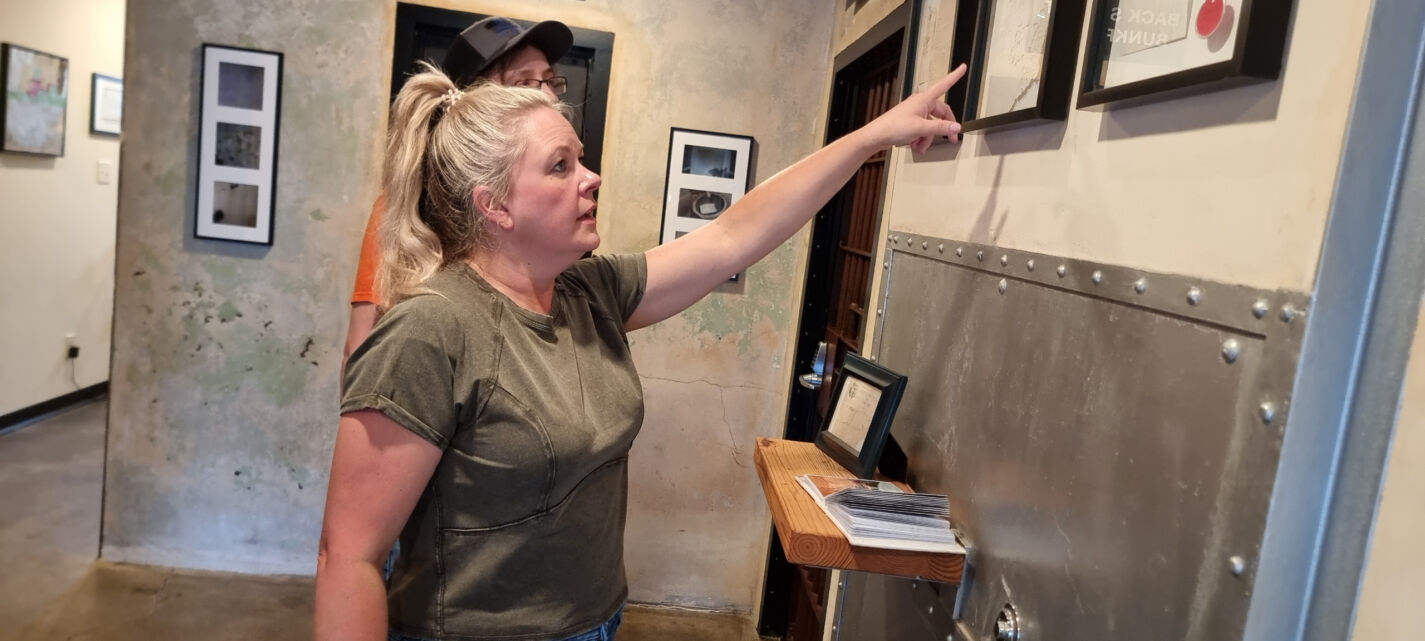
Her first time meeting Copus, she told him about her father’s connection to the jail. He gave her a tour of the new site, during which she spotted her father’s confession in one of the sheriff’s field notebooks decorating the walls.
SPREADING THEIR WINGS
The movement that Norton and Adams were building with their growing collective of balladeers seemed like a perfect way for Copus and his partners to build community buzz about their new hotel and restaurant.
The monthly ballad nights quickly began gaining traction through word of mouth.
But in September 2024, Mother Nature had other plans.
“It was growing and growing, and then the hurricane happened,” Norton said, recalling Hurricane Helene’s devastating rampage through western North Carolina.
“When that happened, it just completely destroyed everything,” she said.
The 27-foot swell from the river reached the hotel’s upper deck and left its patio caked in a layer of mud and silt.
It was the worst flood on record to hit Marshall, shattering the previous record that had stood for more than a century, set the same year Cecil Sharp arrived in town.
“The flood in 1916 went to the top step of the courthouse,” Norton said. “This flood went three feet inside the courthouse.”
Despite the devastation, Copus and the Nest of Singing Birds remained determined to hold the October ballad swap at its usual location.
“This is the only place that we’ve ever had a home for the ballad swap, so that’s what we call it: This is our home,” Norton said.
Norton was pitching in to help get the venue ready when a friend of hers awkwardly offered a spark of inspiration.
“I was down here digging in the mud and … one of my friends said to me, ‘Donna Ray, honey, what are you doing down in Marshall doing the man’s work?’” she recalled.
“And I was like, ‘I’m sorry, what did you just say?’
“He said, ‘You ain’t no spring chicken anymore.’
“And I was like, ‘OK. I am pissed off at you two times now.’
“And then he said, ‘Why don’t you use your gift as a way to help?’
“And I was like, ‘OK, not mad at you anymore. Luckily, you’ve redeemed yourself.’
“And so, I decided that we were going to take the ballad swap on tour to raise awareness that western North Carolina, Tennessee — you know, we were going to be needing help for a really long time because Josh said something that resonated with me, that reopening and staying open are two totally different things,” Norton said.
PUBLIC RECOGNITION
With that, the Nest of Singing Birds launched its first road tour, playing at venues up and down the East Coast and beyond.
Norton and Ritter had the opportunity to open for Old Crow Medicine Show frontman Ketch Secor at a show in Asheville. She again shared the stage with the “Wagon Wheel” singer at the most recent Merlefest last April in Wilkesboro.
Meanwhile, media attention has included articles in national magazines like Rolling Stone and Garden and Gun, as well as an ABC News segment with Diane Sawyer.
But even as her star rises in the folk-music scene, surprisingly one of Norton’s most cherished brushes with fame was meeting the members of Public Enemy backstage at the legendary Newport Folk Festival.
“Like, I love rap music,” Norton said. “Hip hop is my jam.”
Seeing her high-school heroes like Chuck D. and Flava Flav in person, “I was tore all to pieces,” she recalled.
Norton managed to get a picture with the rappers, and afterward she cried in Adams’ lap. “I was like, ‘This is the coolest thing I’ve ever experienced. And who’d have thought, because of ballads, this would be happening?’”
Despite the cultural differences, Norton likened their respective musical traditions to a patchwork quilt.
“We’re all cut from the same cloth, you know; we just need somebody to stitch us back together,” she said.
Editor’s note: The latest version adds that Donna Ray Norton says her father was later acquitted of the homicide.