Democrats have an opportunity to take control of the North Carolina House of Representatives for the first time in more than 15 years, although their chances of winning a majority in the state Senate appear considerably more limited.
Andy Jackson, director of the Civitas Center for Public Integrity at the John Locke Foundation, said during an Oct. 29 appearance on the Do Politics Better podcast that unusually strong Democratic turnout early in the voting period has placed the Republican House majority at risk.
Jackson said the initial turnout numbers suggested Democrats could be on track to capture the chamber, particularly when compared with previous midterm elections.
“Well, I will say they have a legitimate shot at it,” Jackson said. “If you had asked me this question about 10 days ago, I would have said, well, almost certainly, because the Democrats had come out of the gate so strong in early voting. They were well above their typical turnout, even compared to 2018. They were so far above Republicans comparatively.”
Although Republican participation has increased as early voting has continued, Jackson said the electoral environment still presents Democrats with an opportunity to gain control of the House.
“It’s still looking like a good year for Democrats, so I think they still have a legitimate shot at getting that majority,” Jackson added. “I would say it’s probably a slightly better chance that Republicans will hold, but it’ll be a bare hold.”
Republicans have controlled both chambers of the General Assembly since the 2010 elections. They currently hold 71 seats in the 120-member House, compared with 47 Democrats and two unaffiliated lawmakers. Republicans also hold a 30-20 majority in the 50-member Senate.
Democrats need 61 House seats to secure a majority, while Republicans would need 72 seats to guarantee a veto-proof majority.
Two of the current unaffiliated House seats, held by Reps. Carla Cunningham and Nasif Majeed, will have Democratic nominees running unopposed in November. Assuming Democrats win those districts and retain all their other seats, they would need to flip 12 Republican-held districts to reach 61 seats.
In the Senate, Democrats would need a net gain of five seats to produce a 25-25 tie, with Democratic Lt. Gov. Rachel Hunt able to cast tie-breaking votes. A net gain of six seats would give Democrats an outright 26-seat majority.
A path through competitive House districts
The number of competitive districts provides Democrats with more opportunities in the House than in the Senate.
According to the John Locke Foundation’s 2026 Civitas Partisan Index (CPI), seven House districts are classified as toss-ups, while another 15 lean Republican.
The index measures the underlying partisan tendencies of legislative districts using results from nine statewide Council of State races in 2024. It does not account for individual candidates, incumbency advantages, or changes in the political environment.
Under the CPI’s baseline, Democrats would need to win all 47 districts rated safe, likely, or leaning Democratic, along with all seven toss-up districts and at least seven of the 15 Republican-leaning districts to reach a majority.
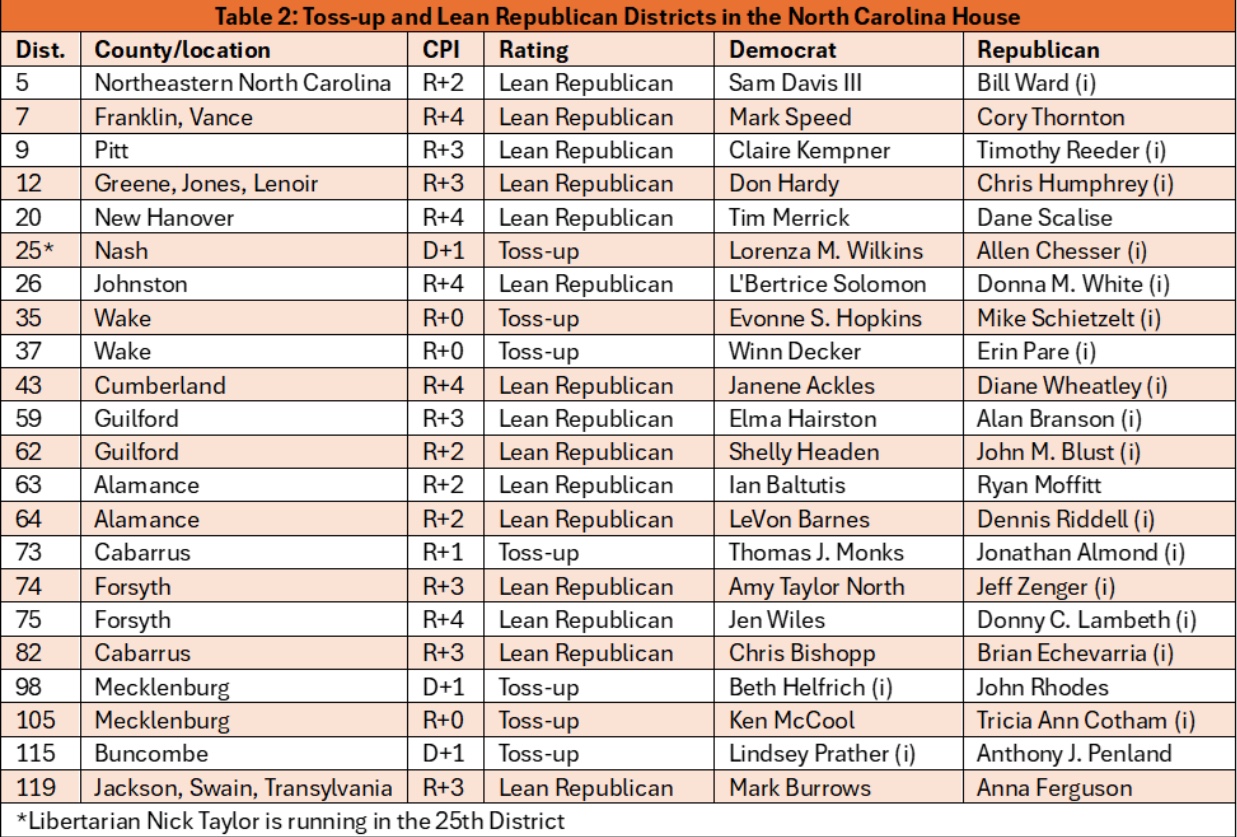
Several of the most closely divided House races are in suburban districts surrounding North Carolina’s largest cities, where shifting voting patterns have made elections increasingly competitive.
In Wake County, Reps. Erin Paré, R-Wake, and Mike Schietzelt, R-Wake, are defending House Districts 37 and 35, respectively. Both districts are rated R+0 by the CPI, indicating that their partisan lean is less than half a percentage point toward Republicans.
Jackson identified both districts as particularly vulnerable to Democratic gains, even as Republicans have improved their statewide early-voting numbers. He pointed specifically to Paré’s history of narrow victories and the difficulty of holding her district in the current political environment.
“Even if the Republican numbers come up, those are among the most vulnerable incumbents in the state,” Jackson said. “Paré has won some pretty close races in the past, but this is probably the fight for political life right now. I think it’s going to be really close.”
In Mecklenburg County, Rep. Tricia Cotham, R-Mecklenburg, is seeking reelection in House District 105, another CPI toss-up. Cotham, the county’s only Republican House member, won reelection by just 213 votes in 2024 and now faces Democrat Ken McCool.
The 2018 midterm election provides a historical comparison for the size of the challenge facing Democrats. During President Donald Trump’s first term, Democrats increased their House total by 10 seats, reducing the Republican majority to 65-55.
Senate majority presents a greater challenge
While the House contains numerous competitive suburban districts, the Senate’s larger districts and Republican incumbency advantages present a different electoral landscape.
The 2026 CPI identifies just three Senate toss-ups and three additional districts that lean Republican. Meanwhile, Republicans hold a partisan advantage in 25 Senate districts classified as likely or safe.
Under that baseline, Republicans would need to win only one of the six toss-up or lean-Republican districts to reach the 26 seats required for an outright majority.
For Democrats to win 26 seats, they would need to sweep all six of those districts, hold their Democratic-leaning seats, and capture at least one additional seat currently classified as likely Republican.
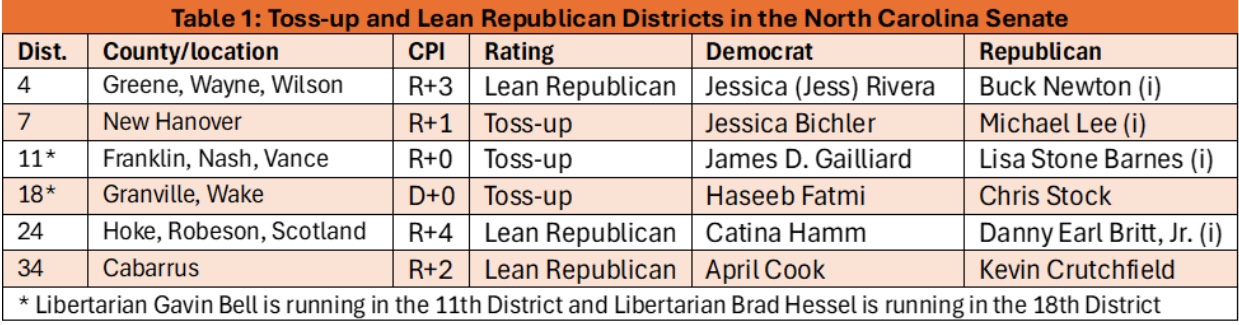
Jackson said the geographic makeup of Senate districts helps explain why Democrats face fewer opportunities to gain seats than in the House, particularly around the state’s largest metropolitan areas.
“The thing about the Senate is they’re bigger districts, and so there aren’t many districts that are trapped on the edge of these urban counties like Wake, Mecklenburg, and Guilford,” Jackson said. “Those are the most vulnerable Republican seats right now.”
One of the most closely watched Senate contests is in New Hanover County, where Senate Majority Leader Michael Lee, R-New Hanover, faces Democrat Jessica Bichler.
The CPI rates Senate District 7 as R+1, placing it among the three Senate toss-ups. Jackson said the district’s competitiveness reflects population changes that have pulled New Hanover County in different political directions.
“New Hanover County is a bellwether county in North Carolina because of the population dynamics,” Jackson said. “You have beach retirees in Brunswick County, who tend to be more Republican. You have an urban center in Wilmington, and the urban areas have been trending more Democratic. Those forces are aligned to keep New Hanover in balance.”
However, Jackson cautioned that the underlying partisan ratings of competitive districts do not necessarily account for an incumbent’s ability to win reelection in an unfavorable political environment.
He pointed to Sens. Buck Newton, R-Wilson, and Danny Britt, R-Robeson, who represent competitive eastern North Carolina districts, as examples of lawmakers whose campaign experience could make their seats more difficult for Democrats to capture.
“A couple of the competitive districts have popular incumbents, including candidates Buck Newton and Danny Britt,” Jackson said. “And they’re proven to be very effective campaigners. And so, even though the numbers indicate they’re close, they’ve always outperformed.”
Those incumbency advantages present an additional obstacle for Democrats, who would need to win several closely divided Senate districts to secure a majority.
Jackson said he does not expect Democrats to win enough of those contests to take control of the chamber, despite the broader political environment.
“I just don’t think the Democrats are going to be able to crack those eastern North Carolina districts,” Jackson said.
Even without a change in control, however, Republicans could lose their veto-proof Senate majority. A net loss of just one seat would leave the party below the 30 votes required to override Democratic Gov. Josh Stein’s vetoes without bipartisan support.
Early voting and polling offer mixed signals
Jackson’s assessment comes as early voting participation has exceeded that during comparable periods in previous midterm elections, with registered Democrats initially accounting for a significantly larger share of ballots cast than registered Republicans.
In an Oct. 26 election analysis, Jackson reported that North Carolina election officials had accepted more than 1.58 million ballots, compared with approximately 1.16 million at the same point in 2022.
Registered Democrats accounted for 41.6% of those ballots, compared with 23.6% from registered Republicans and 34.6% from unaffiliated voters.
However, the Democratic advantage in participation had narrowed considerably since early voting began Oct. 15, as turnout among registered Republicans increased.
Jackson said the initial Democratic surge, combined with strong participation from unaffiliated voters, created the impression that Republicans could face substantial losses. He said subsequent turnout patterns have made the election more competitive than those early numbers initially suggested.
“If you look at it from a numbers standpoint, Republicans are actually a little bit ahead,” Jackson said. “They started off a little bit below, but not terribly below, but Democratic turnout had been so strong, and unaffiliated turnout — presumably disproportionately Democratic-leaning — was so strong that it looked like Republicans were going to get totally swamped. The numbers are starting to balance out a little bit.”
Jackson compared the emerging turnout patterns with previous midterm elections, including the 2010 Republican wave that gave the GOP control of the General Assembly and the 2018 election in which Democrats gained legislative seats.
“As of now, it’s probably about halfway between a Democratic 2010 and a 2018,” Jackson said. “If the trends hold, we’re probably looking at something closer to 2018, which was still a pretty good year for Democrats.”
Recent statewide polling also indicates an advantage for Democratic legislative candidates, though that advantage has narrowed as Election Day approaches.
The October Carolina Journal Poll, conducted Oct. 18-20, found that 48.5% of likely voters preferred Democratic candidates for the General Assembly, compared with 42.7% who preferred Republicans. Another 8.8% were undecided.
The 5.8-percentage-point Democratic advantage was smaller than the 8.2-point lead recorded in September.
However, the same poll found that 46% of likely voters preferred Republican control of the General Assembly to provide a check on Stein’s agenda, compared with 41.2% who preferred Democratic control to support the governor’s priorities.
All 170 legislative seats are on the Nov. 3 ballot. In-person early voting continues through 3pm Saturday, Oct. 31. Election day is Nov. 3.