- North Carolina's attorney general and TikTok are sparring at the state Supreme Court about whether the AG can sue the social media giant in state court.
- TikTok's lawyers argued before the high court Wednesday that AG Jeff Jackson lacks jurisdiction to sue the company in North Carolina.
- Jackson's legal team is urging the state Supreme Court to uphold an August 2025 state Business Court decision allowing the case to proceed.
North Carolina’s highest court will decide in the months ahead whether state Attorney General Jeff Jackson can proceed with his lawsuit in state court against social media giant TikTok.
Lawyers representing Jackson and TikTok argued Wednesday before the North Carolina Supreme Court about whether the social media company’s actions subject it to state court jurisdiction.
An August 2025 state Business Court decision allowed Jackson to move forward with the complaint. TikTok and corporate parent ByteDance are asking the high court to reverse that decision.
“Merely operating a nationally or internationally website or app that is generally accessible to users within a forum — including many, many users within a forum — like it is accessible to users anywhere, does not suffice to establish that forum’s jurisdiction over the website or app operator,” argued Jonathan Hacker, TiTok’s lawyer. “North Carolina should be suing in California, where TikTok is at home and where the underlying conduct occurred.”
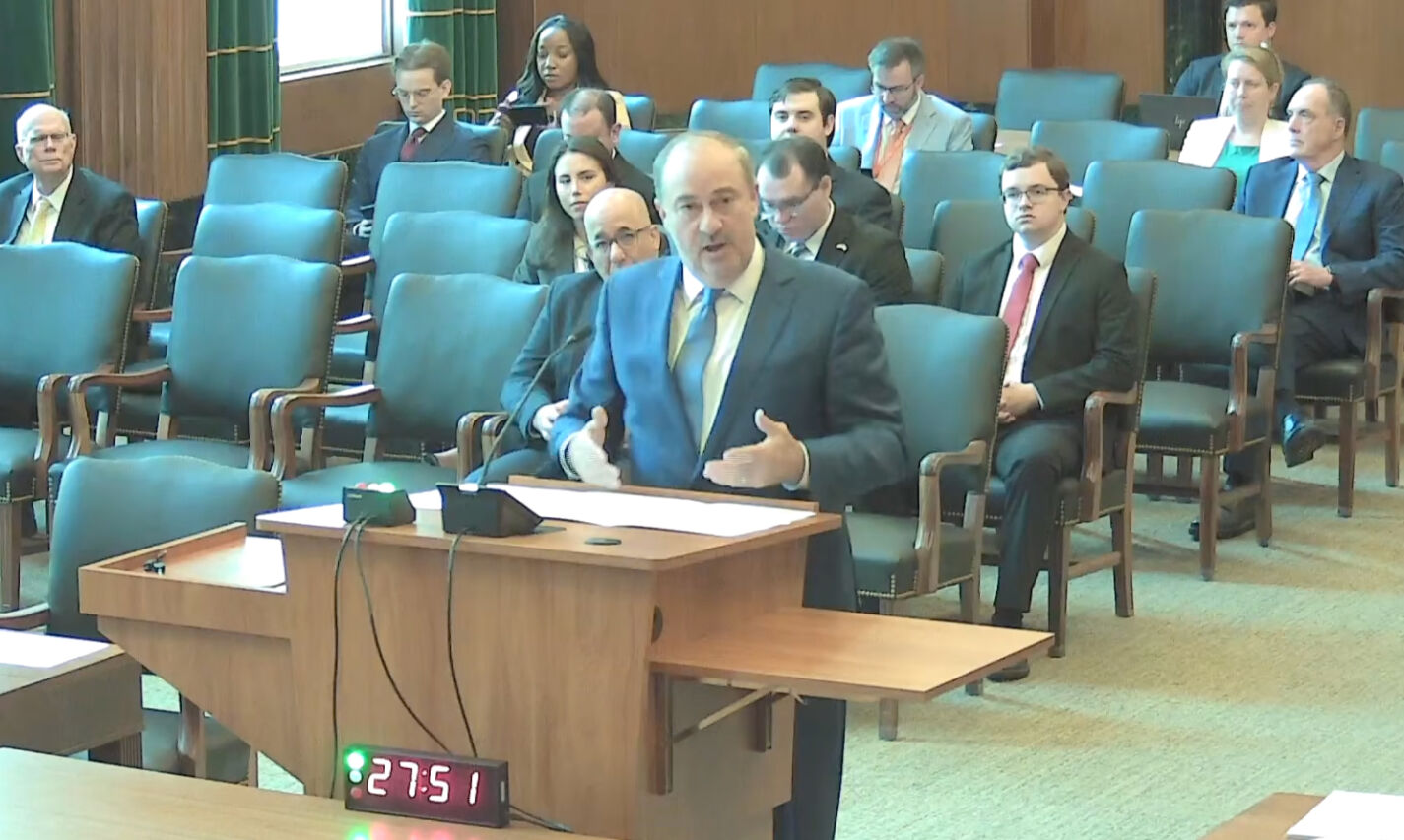
Allowing North Carolina to sue TikTok in this state could open the door to more lawsuits in other states against North Carolina-based companies, Hacker warned. “I think it would subject North Carolina businesses in particular to jurisdiction in far-flung locales whenever somebody interacts with a business in some way and complains about the experience they had with the website.”
“ByteDance would like us to sue in California or, perhaps, in China,” responded Special Deputy Attorney General Joshua Abram. “But their preference is not binding. The state is allowed to choose any forum that has jurisdiction, and the Constitution does not require the state to bring this case in California or Chinese courts. Our own courts can decide our own state’s laws.”
“The state is protecting its children and its families with its statutes,” Abram added. “No other forum’s interests come close.”

TikTok and ByteDance have faced similar suits in other states. “Internet companies have tried this before,” Abram argued. “ByteDance has tried it around the country, and it has failed every time.”
Justices Richard Dietx and Trey Allen questioned Hacker about the impact of TikTok’s algorithm and push notifications. Both justices suggested that the app’s operations could be seen to reach into North Carolina to conduct business.
Justice Allison Riggs noted TikTok’s promotion of its product with parent-teacher groups operating in North Carolina.
“Part of the allegation is that TikTok is holding this out as a program that is safe for children,” Riggs said. “Its PR program is using its relationships with North Carolina PTAs to disseminate this information that this is safe for children.”
“Millions of North Carolinians have downloaded TikTok,” state Justice Department lawyers wrote in an April Supreme Court brief. “Pursuant to TikTok’s terms of use, which these millions of North Carolinians each accepted, ByteDance algorithmically curates a custom stream of endless, automatically updating videos for each user. In exchange, ByteDance harvests reams of personal data from each user, including their location, which ByteDance uses both to customize the content feeds and to deliver targeted advertisements.”
“ByteDance has spent millions of dollars advertising TikTok to North Carolinians and has promoted TikTok in local press and via North-Carolina based organizations,” the court filing continued. “ByteDance reaps a massive profit from its continuous and systematic contacts with North Carolina.”
“Among those millions of North Carolinian users are over a million children,” Jackson’s lawyers wrote. “Many now spend hours every day scrolling through their TikTok feeds, sacrificing time with their families, religious communities, schoolwork, sleep, and overall development. That is no accident. ByteDance intentionally designed TikTok to take advantage of children’s susceptibility to addiction to keep them staring at their screens. The longer children scroll, the more data ByteDance collects, the more advertisements the users view, and the more money ByteDance makes. Worse, ByteDance covered up that misconduct with a deceptive public-relations campaign to North Carolinian parents, advertising tools to prevent compulsive use that ByteDance knows do not work and falsely telling them that the app is safe for children.”
“The State sued ByteDance to remedy this unfair and deceptive conduct,” the brief continued. “ByteDance faces similar lawsuits throughout the country, where it has repeatedly argued that courts in each forum are powerless to redress the harms that ByteDance visits on the children of those states as a result of its nationwide practices. ByteDance makes the same argument here.”
“According to ByteDance, no matter how many millions of North Carolinians exchange personal data with ByteDance every hour of every day, or how many millions of dollars ByteDance makes from that data, only courts in California or Delaware (or, perhaps, Singapore, China, or the Cayman Islands) can address harms arising in North Carolina from North Carolinians’ use of the app,” Justice Department lawyers wrote. “In essence, ByteDance argues that because it does business almost everywhere, it can be held accountable practically nowhere.”
“The Business Court appropriately rejected ByteDance’s implausible understanding of personal jurisdiction,” the brief added. “In a well-reasoned opinion, Judge [Adam] Conrad found that ByteDance ‘has extensive, purposeful contacts with North Carolina’ because it ‘advertises widely in North Carolina, makes TikTok available here, and fosters ongoing relationships with its app’s users.’ And ‘[w]ithout question, ByteDance’s North Carolina-based conduct relates to the State’s claim that TikTok is addictive and harmful to minors and that ByteDance has misrepresented its efforts to make the app safe for their consumption.’”
Conrad rejected ByteDance’s motion to dismiss “for lack of personal jurisdiction.” Other courts across the country have reached the same conclusion, “including three state supreme courts,” Jackson’s lawyers wrote.
“Because clearly established law from the U.S. Supreme Court and this Court refutes ByteDance’s jurisdictional arguments, this Court should affirm,” the brief argued.
TikTok filed a February brief urging the state Supreme Court to throw out Jackson’s suit.
“In this lawsuit, the North Carolina Attorney General (the ‘State’) seeks to use state consumer-protection law to punish seven out-of-state entities for their alleged operation of the TikTok online entertainment platform (‘Defendants’),” company lawyers wrote. “The State claims that Defendants have caused a youth mental-health crisis in North Carolina by making viewing content on the platform ‘addictive’ to minors and falsely representing that viewing content on the platform is ‘safe’ for minors.”
“Although Defendants are confident that further litigation will show that the State’s case is a meritless overreach — violating federal law under Section 230 of the Communications Decency Act and the First Amendment and lacking support in North Carolina law — the case has a more fundamental defect that requires immediate dismissal now, without the need for further litigation: North Carolina courts lack personal jurisdiction over Defendants,” TikTok’s brief continued.
“A state may exercise either ‘general’ or ‘specific’ jurisdiction over a party. It is undisputed that Defendants here are not subject to general jurisdiction in North Carolina — they are not incorporated and do not have their principal place of business here, and their alleged business activities here are not ‘exceptional,’ ‘continuous,’ or ‘systematic,’” TikTok’s lawyers wrote. “The issue is specific or ‘case-linked’ jurisdiction, i.e., whether the State’s particular claims ‘arise out of’ or ‘relate to’ conduct that Defendants allegedly committed in or specifically targeted toward North Carolina.”
“The State’s claims fail that test,” the brief continued. “None of the alleged ‘harmful’ TikTok features was designed in North Carolina or structured to operate differently here. And none of Defendants’ alleged misrepresentations was made in or specifically directed at North Carolina either. Instead, the State’s theory of jurisdiction relied entirely on TikTok’s general accessibility throughout the country and alleged statements made to the general public. But principles of due process are clear: specific jurisdiction does not exist simply because an online platform is accessible in a state or because a public statement is seen or heard there.”
Conrad issued an August 2025 court order denying TikTok’s motions to dismiss the case on various grounds. He also unsealed evidence in the case, including a video that attracted national media attention. The video compiled clips of internal TikTok staff meetings. Staffers raised questions about the app’s impact on teens. TikTok labeled the video “misleading.”
“If the State’s allegations are true, ByteDance has intentionally addicted millions of children to a product that is known to disrupt cognitive development, to cause anxiety, depression, and sleep deprivation, and (in the worst cases) to exacerbate the risk of self-harm,” Conrad wrote in a 29-page order allowing North Carolina’s lawsuit to move forward. “Federal law does not immunize this conduct, the First Amendment does not bless it, and North Carolina’s laws and courts are not powerless to address it.”
Nearly 1 million North Carolinians from ages 13 to 17 used TikTok as of 2023, Conrad noted.
“TikTok features an array of elements allegedly designed to exploit minors’ developmental immaturity and induce compulsive use,” the judge wrote. “TikTok’s home page (coined the ‘For You Page’) feeds each end user videos that are algorithmically selected to maximize engagement. The algorithm, or recommendation system, performs this task by recording the user’s interactions with the app (such as sharing or skipping a video), identifying behavioral patterns, comparing the user’s behavior with others’, and ranking videos as more or less likely to be engaging based on that comparison. This individualized feed is, in the words of ByteDance employees, ‘addictive.’”
The application’s “design choices allegedly make TikTok addictive to minors in much the same way that, say, roulette is addictive to gamblers,” Conrad wrote.
“The State asserts a single claim, based on TikTok’s design and marketing, for unfair or deceptive trade practices under N.C.G.S. § 75-1.1. It claims that ByteDance unfairly designed TikTok to be addictive to minors despite knowledge that compulsive use harms them. It also claims that ByteDance deceived the public by misrepresenting TikTok’s safety features and Community Guidelines while falsely assuring that the app is safe for young users,” the judge explained.
Conrad rejected TikTok’s arguments that a North Carolina court has no jurisdiction over the complaint. “ByteDance advertises widely in North Carolina, makes TikTok available here, and fosters ongoing relationships with its app’s users. All this adds up to the active, purposeful exploitation of a market in North Carolina,” the judge wrote.
The judge also rejected TikTok’s claim of federal immunity and First Amendment protection.
“ByteDance’s chief argument — that consumers can make a free and informed decision to use or not use TikTok — does not reckon with the complaint’s allegations,” Conrad wrote. “The consumers in this scenario are minors, not mature adults. As alleged, ByteDance designed TikTok to exploit the unique vulnerabilities that accompany youthful immaturity, inducing addictive, compulsive use and depriving minors of a free choice.”
“Worse yet, ByteDance did so allegedly knowing that addiction causes social and psychological harms to minors. Taken as true, these allegations outline practices that are ‘immoral, unethical, oppressive, unscrupulous, or substantially injurious’ under section 75-1.1,” Conrad wrote.
Then-Attorney General Josh Stein filed suit against TikTok in 2024. Jackson filed a motion in March 2025 defending the state against the motion to dismiss the case.