Several issues with North Carolina Central University’s (NCCU) procurement card program were identified in an audit released on Monday by the North Carolina Office of the State Auditor (OSA).
The audit examined transactions from July 1, 2025, through Feb. 28, 2026, and was initiated due to identified risks in internal audit reports, prior financial and investigative work by OSA, and a regulation adopted by the UNC System president on university procurement and purchasing card programs.
The findings included transactions that were not reviewed in a timely manner, lacked required supporting documentation, or were approved automatically without supervisory review.
Auditors also identified prohibited purchases, transactions that were split to avoid transaction limits, and card spending limits that were not supported by documented management approval.
UNTIMELY REQUIRED REVIEWS
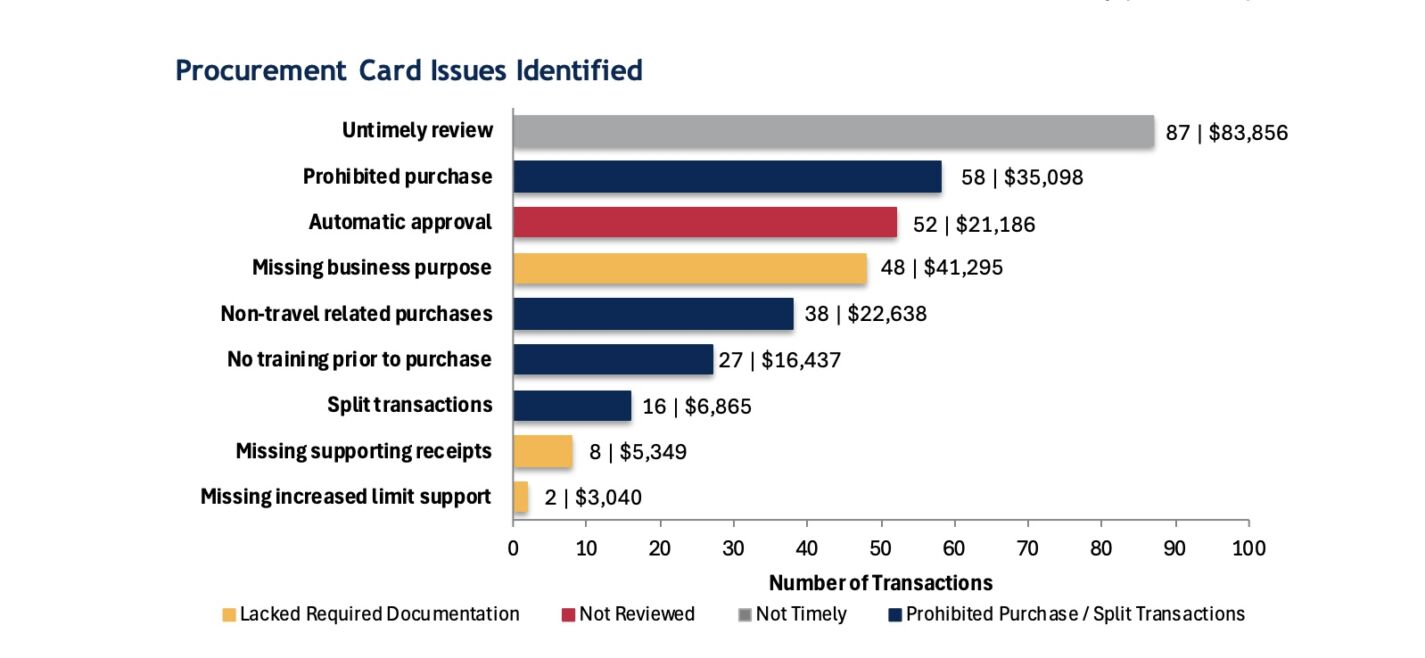
During the audit period, there were 6,027 procurement card (P-Card) transactions totaling approximately $2.8 million. Auditors reviewed 477 P-Card transactions totaling $371,645 and identified 87 (18%) of transactions totaling $83,856 that were not completed within the timeframe required by university policies and procedures. They were completed between seven and 267 days after the required review date.
University management said the issues occurred because compliance with review requirements was not effectively monitored.
P-CARD TRANSACTIONS LACKED REQUIRED DOCUMENTATION
Fifty-six (12%) of the 477 P-Card transactions totaling $46,644 had either missing or incomplete supporting documentation. Eight transactions totaling $5,349 lacked required supporting receipts, and 48 transactions totaling $41,295 lacked a documented business purpose.
University officials said the exceptions occurred because monitoring of the procurement card documentation requirements was inadequate, and cardholders, reviewers, and approvers lacked proper training.
P-CARD TRANSACTIONS AUTOMATICALLY APPROVED WITHOUT SUPERVISORY REVIEW
Fifty-two (11%) of the 477 P-Card transactions totaling $21,186 were automatically approved without supervisory review.
University management told auditors that the system configurations related to approval hierarchies and workflow settings were not periodically reviewed.
P-CARD ACTIVITY INCLUDED PROHIBITED PURCHASES AND SPLIT TRANSACTIONS
There were 139 (29%) of the 477 P-Card transactions totaling $81,038 that didn’t comply with university policy and procedures.
A further breakdown revealed that 27 transactions totaling $16,437 occurred among cardholders who had no prior P-Card training before using one.
Thirty-eight Travel Card or T-Card transactions totaling $22,638 were processed for purchases that didn’t qualify as allowable travel-related expenses.
Fifty-eight P-Card transactions totaling $35,098 were used for purchases expressly prohibited, including purchases for invoice items, vendors who use third-party billing, travel, and subscription services.
An additional 16 transactions totaling $6,865 were used to split five purchases into smaller amounts, thereby keeping them below established transaction limits that would otherwise have been exceeded.
University officials again said the exceptions occurred because there wasn’t adequate monitoring of procurement card documentation requirements, and cardholders, reviewers, and approvers were not properly trained.
P-CARD SPENDING LIMITS EXCEEDED APPROVED AUTHORIZATIONS
During the audit period, the university had 140 cardholders on file. Auditors reviewed the spending limits assigned to all cardholders and found seven (5%) were assigned one or more spending limits that exceeded the limits documented on approved cardholder applications. Of those:
Five cardholders were assigned single transaction limits of $4,999.99 despite approved limits ranging from $1,000 to $2,500. Another five were assigned daily spending limits of $7,500 to $10,000, despite approved limits of $2,500 to $5,000. Six were assigned monthly spending limits of $9,000 to $50,000, despite approved limits of $5,000 to $25,000. This included two cardholders whose approved monthly spending limit was $5,000; however, they were assigned a system limit of $50,000, or 10 times their approved limit.
Additionally, auditors identified two cardholders whose approved single transaction spending limits of $1,000 were temporarily increased to accommodate purchases of $1,790 and $1,250, respectively. However, university management could not provide documentation showing that the temporary increases in limits were approved.
University management told auditors the exceptions occurred because management did not adequately monitor procurement card system settings.
“Oversight and accountability of government credit cards at our public universities, including NCCU, is essential to making sure public dollars are properly spent,” state Auditor Dave Boliek said in an emailed statement to Carolina Journal. “Weak controls create opportunities for unauthorized spending and put university resources at unnecessary risk, which can hurt students and taxpayers. NCCU accepted our findings and recommendations, and some efforts to improve operations are already underway.”
RECOMMENDATIONS
Auditors’ recommendations included:
Strengthen oversight of the card review process by monitoring compliance with review requirements, ensuring supervisory reviews are completed within established timeframes, and promptly addressing instances in which reviews are significantly delayed.
Strengthen monitoring controls over procurement card transactions.
Provide recurring training to cardholders, reviewers, and approvers regarding documentation requirements, allowable purchasing requirements, prohibited purchases, review responsibilities, and approval requirements.
Review and update the procurement card system configurations.
Periodically review all system configurations.
Strengthen enforcement of card usage requirements.
Establish procedures to identify, investigate, and address noncompliant transactions, and to take appropriate corrective action when violations are found.
Periodically review spending limits established within the procurement card system.
University’s response
The university agreed with the auditors’ findings and said it had completed or would complete most corrective actions by Dec. 31.
The university, based in Durham, was previously the subject of an audit released in March 2025. It had over $45 million in financial reporting errors for the fiscal year ending June 30, 2024.