“Have you been into both Conventions?” A journalist asked a former congressman that question in Raleigh in October 1865. Sidney Andrews, on assignment from up North, had come down to cover two political meetings happening at the same time, only a few blocks apart. One was the Constitutional Convention at the Capitol. The other was the Freedmen’s Convention at an African Methodist Episcopal church.
The Confederacy had been defeated, and slavery was ending. The white politicians at the Capitol were working out how to govern in a world that they had never even imagined. Just down the street, black men, most of them newly free, had their own agenda — and it looked nothing like what was sitting on the desks at the Capitol.
Andrews wanted to know how the two groups measured up. The congressman didn’t hesitate: “There isn’t enough loyalty in that whole house to hurt anything. And as for brains, they’re pretty much all over here at the African church.”
The church was a simple white wooden building that had been rolled on raw, hand-cut logs to its location at the corner of Edenton and Harrington Streets 11 years earlier. While the politicos at the Capitol were trying to restrict black freedom from above, the delegates inside the church were clearing a path toward a self-reliant future.
More than 100 black men from across North Carolina had arrived at the Freedmen’s Convention to demand rights they believed were self-evident: the right to testify in court, serve on juries, and stand equal before the law.
To lead as their president, the delegates chose James Walker Hood, a minister who had spent two years as a missionary organizing churches. Hood knew exactly how perilous the political climate was — and was determined to challenge it.
When deciding who would draft their address to the Capitol, the men turned to a strategist of equal prominence and stature: James Harris. An artisan educated at Oberlin College, Harris had spent the war recruiting black soldiers for the Union army and had just returned to Raleigh to teach newly freed people.
Despite their close partnership, the two men did not agree on everything. Hood demanded the vote right then and there. Instinctively knowing the white legislature would instantly reject an outright demand, Harris viewed an immediate push as a faulty strategy and favored a more cautious approach. But instead of making a point, they agreed to secure equal standing under the law first and fight for voting rights later.
They sent their finished address to the Capitol, only to have the politicians stall and bury it.
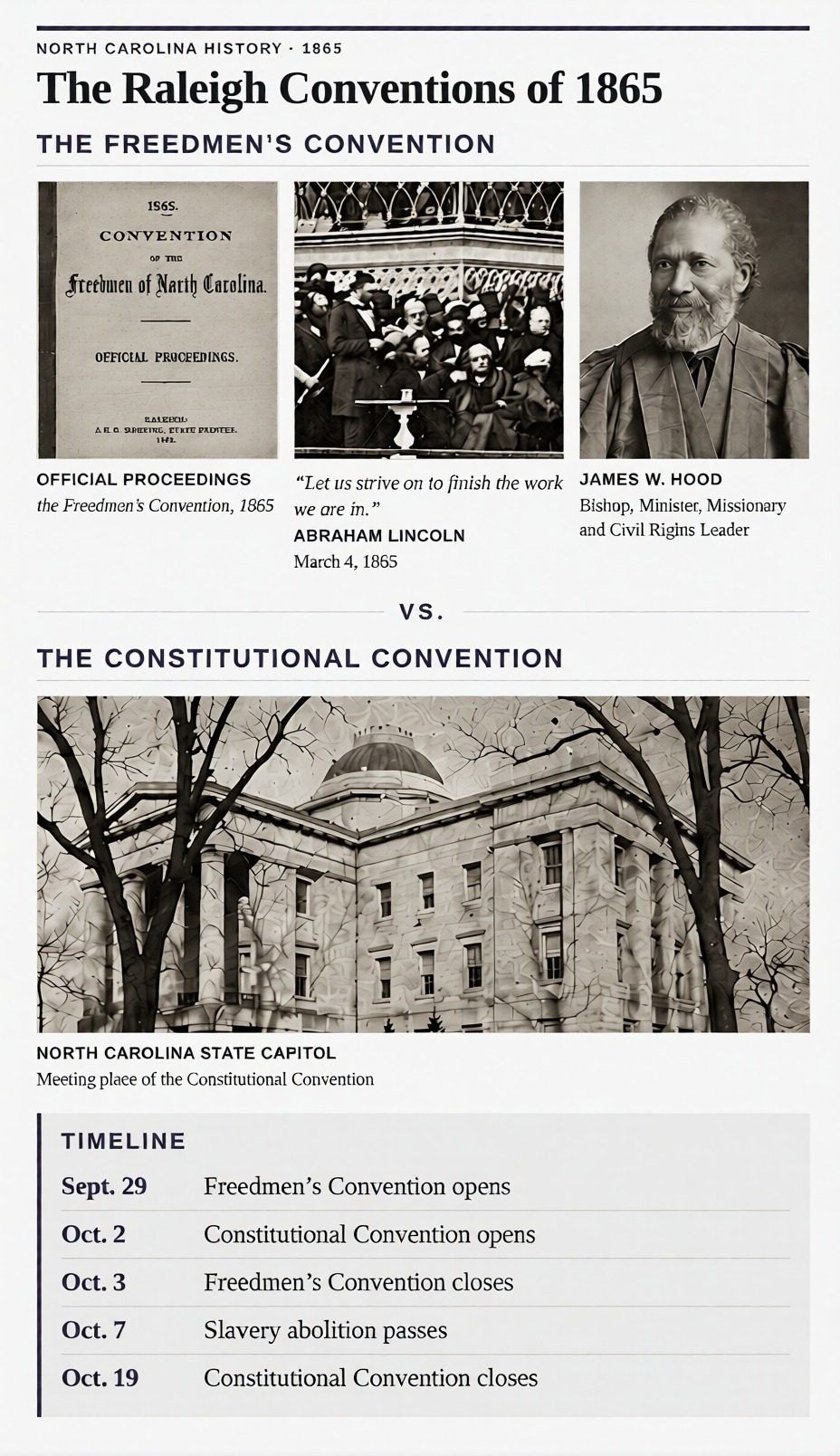
But the men at the church were not finished. High above their pulpit was a plaster bust of Abraham Lincoln, consecrated only five months after his assassination. Overhead hung a canvas inscribed with the final words of Lincoln’s second inaugural address: “With firmness in the right as God gives us to see the right, let us strive on to finish the work we are in.” The delegates did not just view it as a decorative display; they would adopt and carry Lincoln’s words as an enduring sacred covenant.
These men understood that finishing that work required more than asserting their rights to an unresponsive legislature. If the politicians in the Capitol refused to listen, the delegates would meet that silence by forming the North Carolina State Equal Rights League to disperse their political network into every black community in the state.
Education was primary among their goals: Working with aid groups, freedmen built 431 schools for over 20,000 students and laid the groundwork for six historically black colleges during Reconstruction.
That effort began in places like the old Guion Hotel near the Capitol. There, Rev. Henry Martin Tupper began teaching a “theological class” where the Bible was used to teach formerly enslaved people how to read and write. The class became a school, which later became Shaw University. Its graduates later established both North Carolina Central University and Elizabeth City State University. Hood went on to establish Livingstone College, leading its trustees for over 30 years.
Yet the Conservative faction had no intention of relenting. While black citizens were building classrooms, the state legislature was busy throwing up barriers. In 1866, the legislature enacted the state’s “Black Codes” and later rejected the proposed 14th Amendment which sought to grant citizenship and guarantee newly freed blacks equal protection under the law.
Then came a devastating riposte to the old regime. Infuriated by the South’s deliberate resistance, the Radical Republicans in Washington took control and passed the Reconstruction Acts of 1867, placing North Carolina under US military rule. Under protection of the army, top Confederate leaders were barred from public office while 72,000 black men were registered to vote.
Desperate to regain control, the Conservative leadership tried to weaponize a federal loophole that required a majority of all registered voters to cast ballots for the election to count. They ordered white voters to stay home, banking on a technical failure. But the gamble backfired as an overwhelming black turnout validated the election, swinging the doors of the Capitol wide open for the Radical Republicans and their black allies to take control of the state.
By 1868, Hood, Harris, and 13 other black leaders no longer had to deliver their requests to those in the old wooden desks at the Capitol; they walked inside and sat down at them to rewrite the state’s constitution at the 1868 Constitutional Convention.
It is not known if the congressman’s remark about the “brains” at the church was a sardonic jab at his own colleagues or a compliment, but history proved him exactly right.
For nearly 10 years after the Civil War, black men voted, won elections, and held office for the first time in history. And while white Democrats managed to retake the legislature in 1870 and the Governor’s Mansion in 1876, black voices were far from silenced.
By the 1890s, white farmers who were broke and drowning in debt sought to unseat the wealthy Democrats whose policies had squeezed rural families into economic ruin. They joined forces with black Republicans to run on a single “Fusion” ticket, broke the Democratic hold on the state, and put power in favorable hands to equal rights.
But white supremacists lunged forward with a counter-thrust that would dictate the rules of governance for the next half-century. An underground committee of Wilmington businessmen known as the Secret Nine deployed an armed militia called the Red Shirts to terrorize black voters and stage an 1898 coup d’état on the streets of the coastal city, which was the largest in the state at the time.
By 1900, the legislature was right back in charge. And to ensure the opposition could never strike back, it amended the North Carolina constitution with poll taxes, literacy tests, and a “grandfather clause” to strip black citizens of the vote. The General Assembly then codified Jim Crow into law, segregating public life permanently — or so they thought.
They had rewritten the constitution, but because of the black delegates’ foresight in 1865, their covenant would prove unstoppable — that promise to finish Lincoln’s work did not rely on the Capitol; it relied on an education that could never be stripped away. Shaw and Livingstone did not depend on the state to remain open. Neither did Fayetteville State University, founded in 1867 by seven black citizens, or the institutions that became Elizabeth City State University and North Carolina Central University.
The struggle to reclaim the franchise spanned more than a half-century. It ultimately took an ironclad grassroots system — anchored by black churches and colleges — to finally shatter Jim Crow when federal power stepped in through the Civil Rights Act of 1964 and the Voting Rights Act of 1965.
This all began with only a handful of delegates in a simple wooden building who refused to wait for legislative permission to secure their own future. By enacting their own strategy of self-reliance and an education that the state could not touch, they parried the politicos who opposed them.
The coercive laws enforced at those Capitol desks eventually collapsed, while the parallel institutions built by the black congregation at the church prevailed. The old guard used every legislative weapon the government could provide, but in the end, the duel was over, and the church house had won.