Voting is underway in North Carolina, with absentee ballots already in voters’ hands ahead of the Nov. 3 general election. The election features federal and state races, along with three proposed constitutional amendments.
County boards of elections began sending absentee ballots Sept. 4, making North Carolina the first state to begin voting in the 2026 midterm election. The first batch went to more than 46,000 voters who had requested ballots.
What appears on an individual ballot will vary based on where a voter lives, particularly for congressional and legislative races. The State Board of Elections’ Voter Search allows voters to view their districts, Election Day polling place, and finalized sample ballot.
The General Assembly also offers a “Find Your Legislators” tool that allows residents to identify their current US House, NC House, and NC Senate representatives, as well as the districts associated with their address.
US Senate
North Carolina voters will elect a successor to Republican US Sen. Thom Tillis, who is not seeking reelection.
The ballot includes Democrat Roy Cooper, Republican Michael Whatley, Libertarian Shannon W. Bray, and Green Party candidate Michael Dublin.
Cooper served two terms as North Carolina governor from 2017 through 2024 after serving 16 years as state attorney general. Whatley previously chaired the Republican National Committee and the NC GOP. He is making his first run for elected office.
The race has also attracted substantial national spending and attention. Senate Majority PAC, which supports Democratic Senate candidates, announced $31.4 million in television reservations supporting Cooper, while the Republican-aligned Senate Leadership Fund announced plans to spend $71 million backing Whatley.
National Republican officials have campaigned in North Carolina for Whatley. President Trump held a rally with him in Gastonia on Sept. 16, followed by Vice President JD Vance at a rally in Greensboro on Sept. 21.
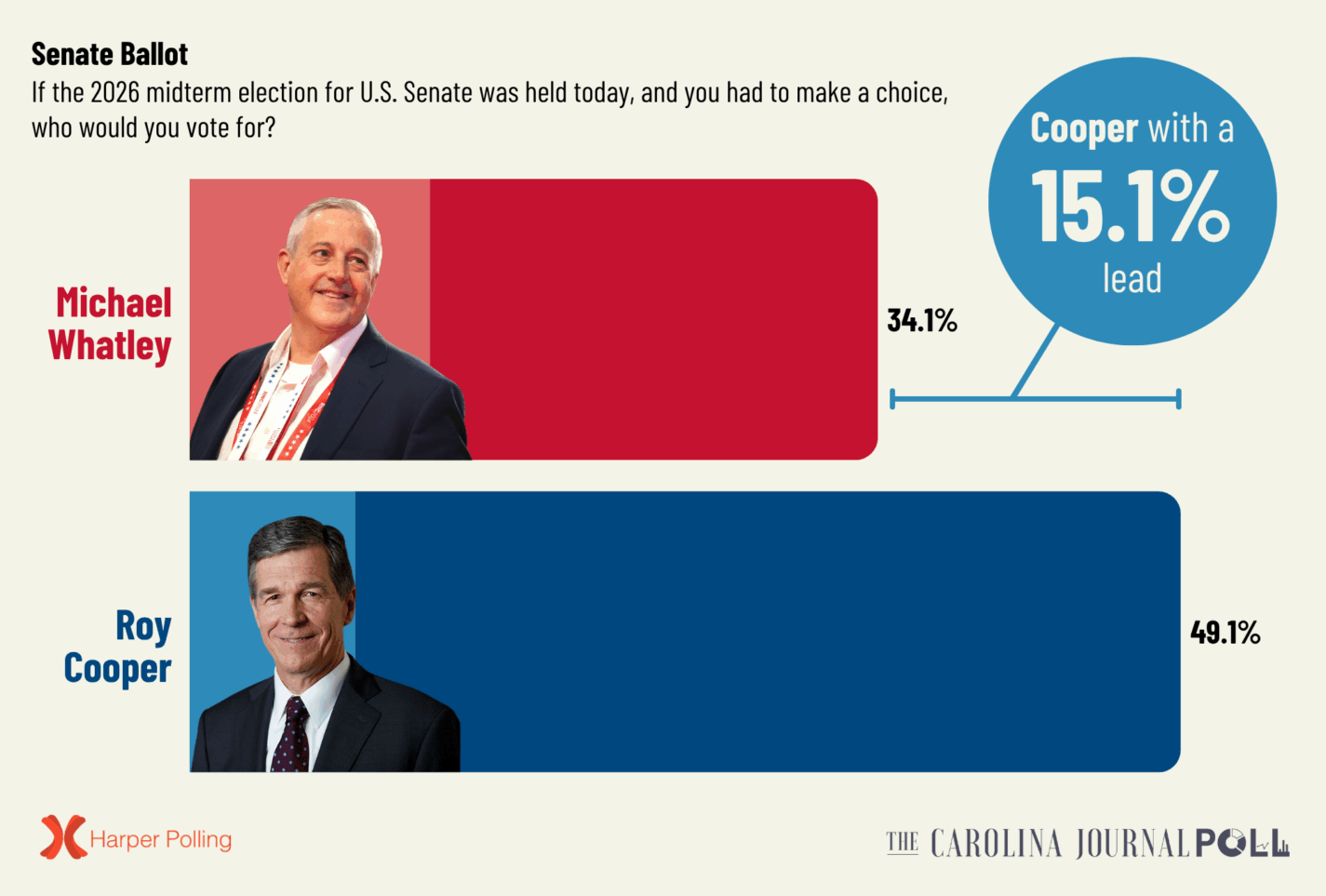
The latest Carolina Journal Poll, conducted Sept. 13-15 among 608 likely North Carolina voters, found 49.2% supporting Cooper and 34.1% supporting Whatley. Bray received 2.9%, Dublin 1.5%, and 12.3% were undecided.
US House
All 14 of North Carolina’s US House seats are on the ballot. Voters will see only the congressional race for the district where they live.
The Democratic and Republican nominees in each district are:
- District 1: Democrat Don Davis vs. Republican Laurie Buckhout
- District 2: Democrat Deborah Ross vs. Republican Eugene Douglass
- District 3: Democrat Raymond Smith vs. Republican Greg Murphy
- District 4: Democrat Valerie Foushee vs. Republican Max Ganorkar
- District 5: Democrat Chuck Hubbard vs. Republican Virginia Foxx
- District 6: Democrat Cyril Jefferson vs. Republican Addison McDowell
- District 7: Democrat Kimberly Hardy vs. Republican David Rouzer
- District 8: Democrat Colby Watson vs. Republican Mark Harris
- District 9: Democrat Richard Ojeda II vs. Republican Richard Hudson
- District 10: Democrat Ashley Bell vs. Republican Pat Harrigan
- District 11: Democrat Jamie Ager vs. Republican Jennifer Balkcom
- District 12: Democrat Alma Adams vs. Republican Jack Codiga
- District 13: Democrat Paul Barringer vs. Republican Brad Knott
- District 14: Democrat Lakesha Womack vs. Republican Tim Moore
The state’s two most competitive congressional contests are in the 1st and 11th districts. The Civitas Center for Public Integrity classifies both as competitive Republican-leaning districts, with NC-1 rated R+5, and NC-11 rated R+4.
In the 1st District, Davis and Buckhout are meeting in a rematch of their 2024 contest, when Davis won 49.5% of the vote to Buckhout’s 47.8%, a margin of just over 6,000 votes. State lawmakers redrew the district in 2025, shifting its partisan makeup toward Republicans ahead of this year’s election.
The 11th District contest changed significantly in August, when Republican US Rep. Chuck Edwards withdrew from his reelection campaign following a House Ethics Committee report that concluded he violated the rules on sexual harassment of staff. Republican leaders in the district subsequently selected state Rep. Jennifer Balkcom to replace Edwards on the ballot against Democrat Jamie Ager.
On the September Carolina Journal Poll’s generic congressional ballot question, 51.1% of likely voters said they would support a Democratic candidate for Congress, compared with 41.9% who chose a Republican candidate.
North Carolina House and Senate
The entire North Carolina General Assembly is up for election this year.
All 50 NC Senate seats and all 120 North Carolina House seats are on the November ballot. Each voter will elect one senator and one representative based on their legislative districts.
Members of both chambers serve two-year terms with no term limits, so all 170 legislative seats can be contested in even-numbered years.
Republicans are seeking to maintain control of both chambers for the 2027-28 session. The party currently holds a 30-20 majority in the Senate and a 71-49 majority in the House. Republicans have controlled both chambers of the General Assembly since 2011.
The current margins also put veto power in play. Republicans hold exactly the three-fifths Senate majority needed to override a governor’s veto, while their 71 House seats are one short of the 72 needed when all 120 members vote.
The September Carolina Journal Poll found 49.5% of likely voters choosing a Democratic candidate on a generic state legislative ballot, compared with 41.3% choosing a Republican.
Supreme Court and Court of Appeals
Four statewide appellate court races will appear on every ballot.
For the North Carolina Supreme Court, incumbent Democratic Justice Anita Earls faces Republican Sarah Stevens for Associate Justice Seat 1. The September Carolina Journal Poll found that 47.2% of likely voters supported Earls and 36.4% supported Stevens.

Three NC Court of Appeals seats are also up for election:
- Seat 1: Republican Michael C. Byrne vs. Democrat John S. Arrowood
- Seat 2: Republican George Cooper Bell vs. Democrat Tobias “Toby” Hampson
- Seat 3: Republican Craig Collins vs. Democrat Christine Marie Walczyk
Supreme Court justices and Court of Appeals judges are elected statewide to eight-year terms. The State Board has published an online Judicial Voter Guide with information submitted by each candidate.
Three constitutional amendments
Every voter will also decide three proposed amendments to the North Carolina Constitution.
The first would require “all voters, not just those presenting to vote in person, to present photo identification before voting.”
State law already requires absentee-by-mail voters to provide a copy of an acceptable photo ID or complete an ID Exception Form. The amendment would extend the constitutional voter ID language, which voters approved for in-person voting in 2018, to all voters.
The September Carolina Journal Poll found 66.4% of likely voters supported the amendment, while 28.8% opposed it.
A second amendment would lower the cap on the maximum state income tax rate permitted under the Constitution from 7% to 3.5%. Voters approved the current 7% cap in 2018, lowering it from 10%.
The CJ Poll found that 66.9% supported the proposed 3.5% constitutional cap, while 23.6% opposed it.
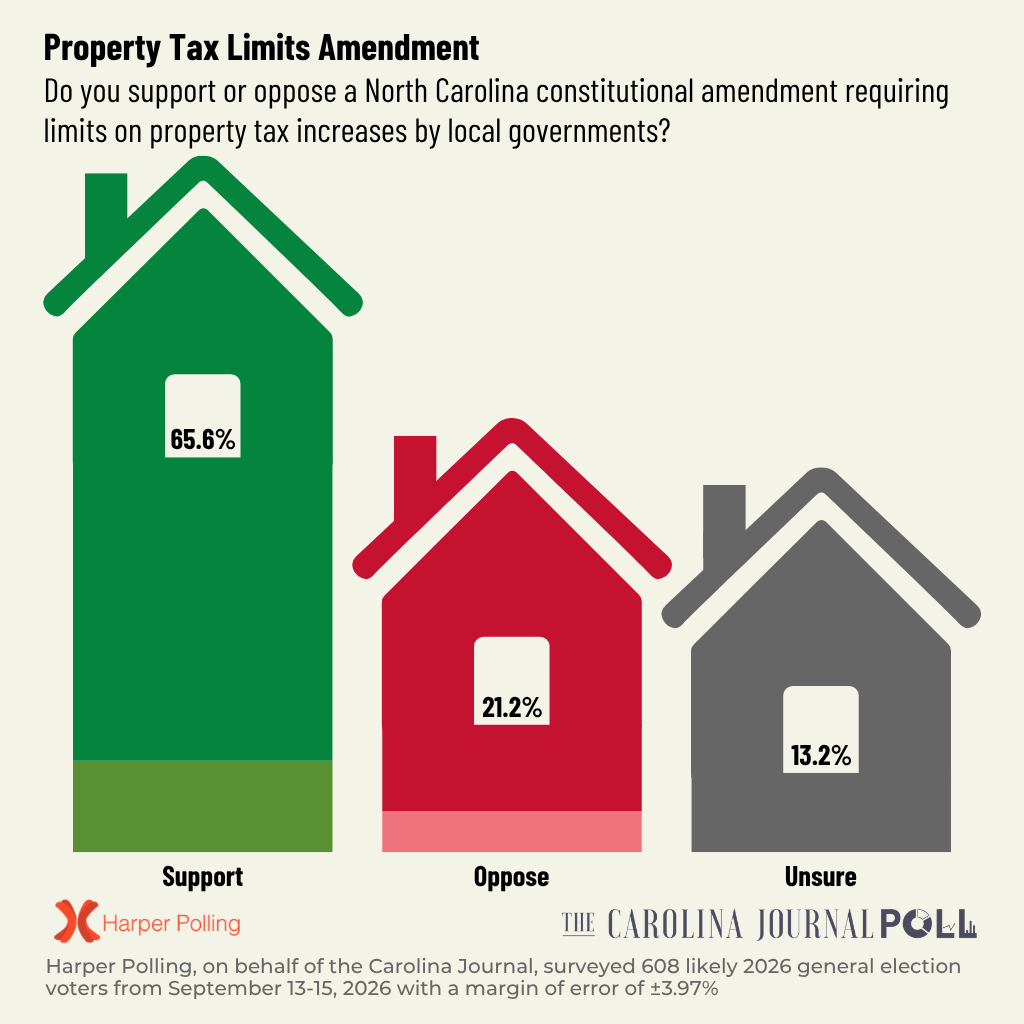
The third amendment would require the General Assembly to enact limits on increases in local governments’ property tax levies. A levy limit restricts growth in the total amount of property tax revenue collected rather than simply setting a maximum tax rate.
The September CJ Poll found 65.6% supported that amendment, while 21.2% opposed it.
Key voting dates
The regular voter registration deadline is 5pm Oct. 9. Voters who miss that deadline can still register and vote at the same time during the in-person early voting period, which begins Oct. 15 and runs through 3pm Oct. 31.
The deadline to request an absentee-by-mail ballot is 5pm Oct. 20. Completed absentee ballots must be received by the voter’s county board of elections by 7:30pm on Election Day, Nov. 3.
Polls on Election Day are open from 6:30am to 7:30pm, and voters must cast their ballots at their assigned polling places.
North Carolina voters are asked to show an acceptable photo ID when voting in person. Absentee-by-mail voters are generally required to include a photocopy of an acceptable ID with their returned ballot or complete an ID Exception Form.